


A professional-grade robotic mower is a significant investment in your property and your time. Treating its winter storage as an afterthought—a quick clean and charge—is like putting a fine watch in a drawer without winding it. Proper off-season preparation isn’t just about storage; it’s a critical maintenance ritual that safeguards performance, extends lifespan by years, and ensures a flawless first start next spring.
As the mowing season ends in much of the U.S., your robotic mower’s job transitions from active duty to protected hibernation. For high-end models with sophisticated 4WD systems, AI vision, and precision GPS, this period demands more than a casual wipe-down. Following this definitive 5-step tune-up protocol will transform your mower from a seasonal tool into a reliable, long-term asset.
The Core Philosophy: From Storage to System Preservation
Winter is not a passive pause but an active preservation phase. Humidity, temperature swings, and chemical inactivity (in batteries) are the off-season’s enemies. This process mitigates those risks through methodical, science-backed steps.
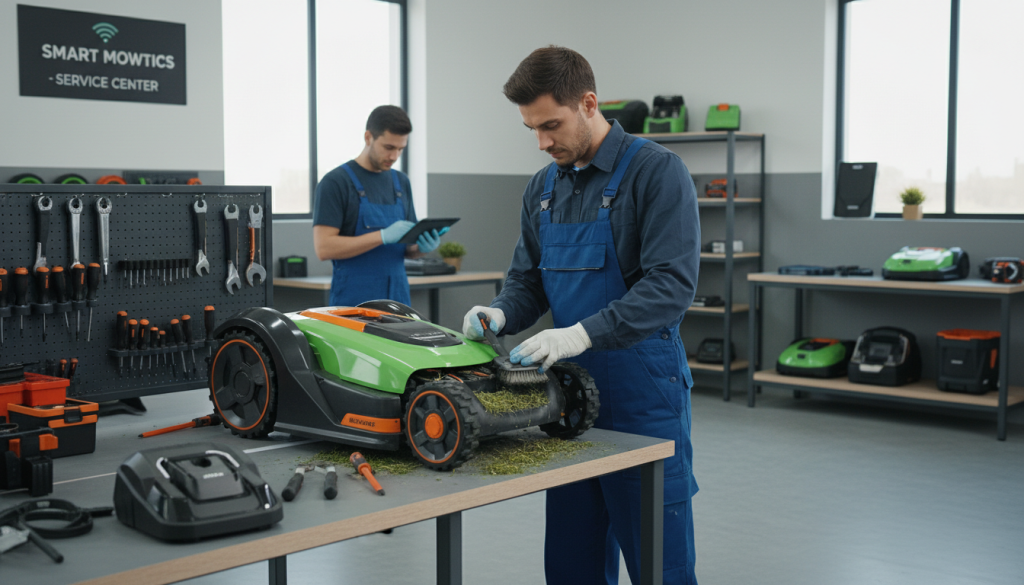
Step 1: The Forensic Clean – Beyond Aesthetics
Objective: Remove all organic and corrosive residues that degrade materials and impair sensors during months of idle time.
The Professional Protocol:
-
Undercarriage Decontamination: Use a plastic scraper and garden hose (not a pressure washer) to remove packed grass, mud, and thatch. Stuck-on debris holds moisture against the chassis, promoting rust and corrosion on electrical contacts.
-
Sensor & Lens Surgery: This is critical for AI and navigation systems.
-
Cameras/LiDAR: Use a blower bulb first to dislodge dust. Then, clean lenses with a microfiber cloth and 90%+ isopropyl alcohol, wiping in a single direction. Never use window cleaner or abrasive cloths.
-
Ultrasonic Sensors: Gently clean the sensor faces with a cotton swab and isopropyl alcohol.
-
Charging Contacts: Clean with electrical contact cleaner and a soft brush to ensure perfect connectivity next spring.
-
-
Drive System Flush: For 4WD models, spray the wheel axles and gear housings with a water-displacing lubricant (like WD-40 Corrosion Inhibitor) to drive out moisture and leave a protective film.
Step 2: The Battery Ritual – Mastering Lithium-Ion Chemistry
Objective: Preserve battery capacity and prevent the single most common cause of premature failure.
Why This is Non-Negotiable: Storing a lithium-ion battery at 100% charge creates high internal stress, accelerating capacity loss. Storing it fully drained can push voltage too low, causing irreversible damage.
The Gold-Standard Procedure:
-
Final Run & Partial Drain: For the last mow of the season, schedule a run that leaves the battery at approximately 30-40% charge. This is the sweet spot for long-term storage voltage.
-
Official Storage Mode: If your mower’s app (like Goko’s) has a “Long-Term Storage” or “Winterize” mode, use it. This electronically prepares the battery management system (BMS).
-
Disconnect & Isolate: If possible, physically remove the battery from the mower. Store it indoors in a dry, temperature-stable environment (ideally 50-70°F / 10-21°C). An unheated garage subject to freezing temperatures can permanently damage the cells.
-
Mid-Winter Check (Optional but Ideal): Around mid-January, plug the battery in to bring it back to 30-40% if it has self-discharged, then disconnect again.
Step 3: The Mechanical Review – A Pre-Hibernation Physical
Objective: Identify and address wear now to avoid spring breakdowns.
The Inspection Checklist:
-
Blades & Disc: Remove and inspect cutting blades and the disc assembly. Look for bends, chips, and excessive wear. Sharpen or replace them now. Installing fresh blades in spring is ideal, but preparing them now ensures you’re ready.
-
Tire & Wheel Integrity: Check for cracks, dry rot, or severe wear on tires. Spin each wheel, listening for grinding sounds from bearings—a sign of needed service.
-
Structural Check: Examine the chassis for any hairline cracks, especially around stress points like the front bumper or wheel mounts.
Step 4: The Software & Data Shutdown – Archiving the “Season’s Mind”
Objective: Preserve mapping data and update intelligence for a smarter return.
The Digital Protocol:
-
Final Map Backup & Review: In your app, save a copy of your final, perfected season map. Review it, noting any areas for adjustment (new garden beds, removed trees).
-
Firmware Updates: Perform any available end-of-season firmware updates before storage. Manufacturers often release updates that improve cold-weather logic or navigation algorithms.
-
Data Export (For Enthusiasts): Some advanced systems allow export of season data (hours per zone, error logs). This is valuable for tracking performance trends.
Step 5: The Sanctuary – Creating the Ideal Storage Environment
Objective: Shield the system from environmental aggression.
The Ideal Storage Setup:
-
Location: A clean, dry, temperature-controlled indoor space is paramount. A basement shelf or closet is superior to a garage.
-
Position: Store the mower on its wheels, not on its side. If storing the docking station, ensure it is completely dry.
-
Cover: Use a breathable cloth cover (like an old cotton sheet)—not plastic, which traps condensation and promotes mold and corrosion.
-
The Charger: Store the charger indoors with the battery, not in a damp outdoor shed.
The Spring Re-Awakening: Your Pre-First-Mow Checklist
When temperatures stabilize above 40°F consistently:
-
Reunite & Charge: Reinstall the battery and give it a full, uninterrupted charge.
-
Sensor Diagnostic: Run the app’s built-in sensor check or calibration routine.
-
Supervised Test Run: Initiate a short, supervised test in an open area. Verify that navigation, obstacle avoidance, and docking function perfectly.
-
Install Sharp Blades: Fit your newly sharpened or replacement blades.
Conclusion: The Dividend of Discipline
This 5-step tune-up is an investment of an hour that pays a multi-year dividend. It directly protects the four pillars of your mower’s value: its hardware integrity, battery longevity, software intelligence, and operational readiness.
For the owner of a premium robotic system, this disciplined ritual is the difference between perceiving your mower as a disposable gadget and stewarding it as a refined, enduring piece of property-enhancing technology. When spring arrives, you won’t be troubleshooting a sluggish machine; you’ll be unleashing a perfectly preserved partner, ready to deliver another season of flawless, silent service. That is the ultimate return on your winter-proofing investment: absolute peace of mind.