

Mulching: Your Lawn’s Free Natural Fertilizer
Did you know that the grass clippings bagged and discarded across America every year contain nitrogen equivalent to millions of tons of synthetic fertilizer? This represents not only a massive waste of resources but also means you’re paying extra for nutrients your lawn has already produced for free. Understanding and correctly applying grasscycling—the practice of leaving clippings on the lawn—can revolutionize your turf’s health and your maintenance costs.
Every time you start your mower, you face a simple choice: bag or leave behind? Conventional wisdom held that leaving clippings led to thatch buildup and an unkempt appearance. However, modern horticultural science and smart mowing technology have completely this notion. Properly executed grass mulching is not only the most efficient way to feed your lawn but also the key to sustainable, low-input, high-return yard care.
01 The Science: Nature’s Perfect Cycle, In Your Backyard
A lawn is not a static decoration but a dynamic, living ecosystem. Grass blades are roughly 85% water and 15% organic matter (primarily carbon, nitrogen, phosphorus, potassium). When you mow, you are cutting away concentrated packets of plant nutrients.
How Grasscycling Works:
-
Instant Nutrient Return: Finely chopped and evenly dispersed clippings begin to decompose within 24-48 hours upon contact with moist soil and microbes. Up to 25% of the nitrogen (N) released can be directly reused by the lawn in the current growing season, creating an “instant green-up effect.”
-
Activates the Soil Food Web: Clippings are a “feast” for soil microorganisms (bacteria, fungi). These microbes break down organic matter into humus—a dark, crumbly, nutrient-rich substance that is the soul of healthy soil. A robust microbial community helps grass roots absorb water and nutrients more efficiently and suppresses pathogens.
-
Natural Moisture Regulator: A thin layer of organic residue on the soil surface can significantly reduce evaporation (by up to 25%), providing a cooler, moister environment for roots during hot summers.
Key Data:
For every 1,000 square feet of lawn per year, grasscycling can recycle approximately 2-3 pounds of natural nitrogen. This meets 25%-40% of your lawn’s annual nitrogen needs, completely free of charge.
02 Debunking Myths: Why Your Past Mulching Efforts May Have Failed
Many who claim “mulching doesn’t work” or “causes thatch” typically executed it improperly. Failure stems from two main reasons:
Failure Cause #1: Clippings Were Too Large and Wet.
Using dull blades or a traditional mower on wet, overgrown grass creates long, wet clumps of grass. These clumps cannot disperse evenly and form a dense, matted “blanket” on the surface. This blanket blocks sunlight, air, and moisture, genuinely suffocating the grass, causing yellowing, and promoting disease—this is the dreaded thatch buildup people fear.
Failure Cause #2: Mowing Frequency Was Too Low.
This is the root cause. The traditional “once-a-week” mowing schedule forces you to remove too much grass at once. Even with a mulching mower, it’s challenging to finely shred such a large volume of material.
03 The Secret to Success: Small, Frequent, and Fine
For grasscycling to succeed, you must follow the golden rule of “little and often.” This is precisely the design philosophy of robotic lawn mowers and explains why they are the ideal tool for this task.
The Three Elements of Perfect Grasscycling:
-
Take Little: Only remove the grass tip (no more than 1/3 of the blade height) each time. This produces clippings so small they are barely visible.
-
Cut Often: During the growing season, the ideal frequency is every 2-3 days. This ensures the amount of grass processed each time is minimal.
-
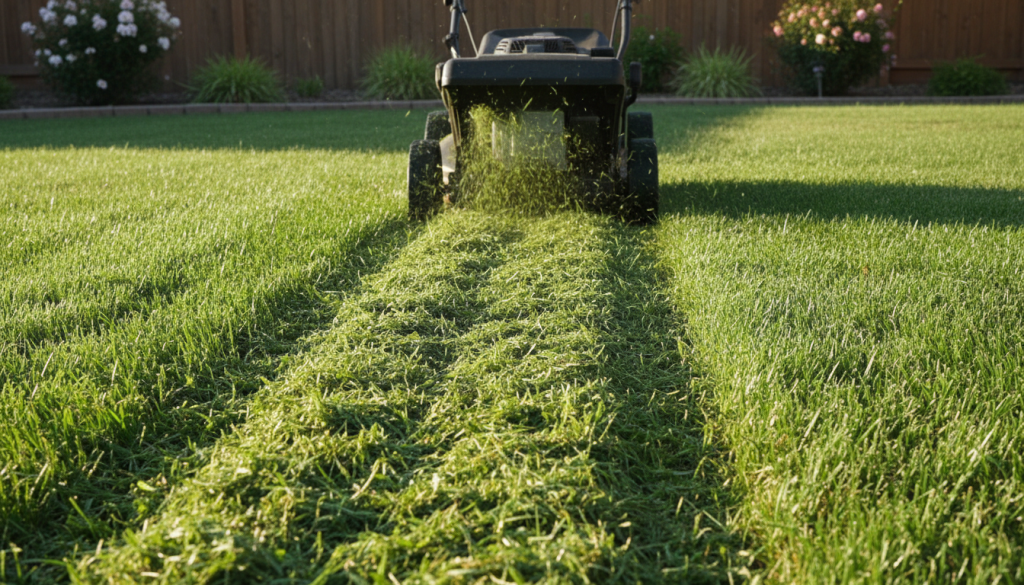
Cut Fine: Use sharp, specifically designed dual or mulching blades to chop clippings into pieces smaller than 1/2 inch. These tiny pieces easily fall to the soil surface through the grass canopy and disappear rapidly.
A robotic mower equipped with dual mulching blades (like Goko’s design) is born for this task: It operates automatically daily or every other day, taking only millimeters off the grass tips and instantly shredding them into dust with high-speed, sharp blades. When you see a faint “green mist” on the lawn at dawn that completely vanishes by noon—that’s grasscycling working perfectly. The lawn has “digested” its own clippings, leaving no trace.
04 Five Key Benefits: Beyond Saving on Fertilizer
Correctly implemented grasscycling creates a complete positive cycle for your lawn:
-
Continuous Free Nutrition: It’s like establishing a slow-release “nutrient savings account” for your lawn. You avoid the risks of fertilizer burn or runoff from poorly timed applications, as the turf can draw nutrients as needed.
-
Revolutionary Soil Improvement: The ongoing addition of organic matter (humus) significantly improves soil structure. Clay soil becomes looser and better-draining; sandy soil gains better water and nutrient retention. This means less irrigation is needed and greater drought resistance.
-
Ecological & Environmental Contribution:
-
Reduces Landfill Waste: EPA data shows yard waste accounts for 12%-20% of municipal solid waste. Stopping bagging clippings is a direct benefit to the environment.
-
Reduces Chemicals: Lower dependence on synthetic fertilizers reduces the carbon footprint of their production and minimizes nutrient runoff into local waterways.
-
-
Enhanced Lawn Resilience: A lawn built from healthy soil with balanced nutrition has a much greater inherent ability to resist pests, diseases, drought, and temperature extremes. You’ll see a noticeable reduction in the need for pesticides and fungicides.
-
Saves Time & Money: It eliminates the heavy labor of bagging, the cost of trash bags and disposal fees, and a portion of fertilizer expenses. The savings are especially significant for large properties.
05 Your Action Plan: How to Start Your Grasscycling Program
If You Use a Traditional Mower:
-
Invest in a sharp mulching blade kit.
-
Adhere to the “One-Third Rule” and increase mowing frequency. If the grass is too tall, mow at a high setting first, then lower the deck for a second mulching pass a few days later.
-
Always mow when the grass is dry.
-
Consider purchasing a dedicated mulching mower. Its specialized blade and deck design creates better airflow to cut clippings multiple times and blow them deep into the turf.
If You Seek Ultimate Efficiency and Results (Highly Recommended for Large Lawns):
Embrace Smart Automation. A well-designed robotic mower is the ultimate tool for executing perfect grasscycling. It automatically solves all the core challenges:
-
Automates frequent, light mowing.
-
Always uses sharp blades for a fine cut.
-
Works at the optimal time (early morning when grass is dry), whether you’re home or not.
-
Your only “job” is to enjoy a progressively healthier, lusher lawn.
Conclusion: The Shift from “Waste Manager” to “Ecosystem Steward”
Grasscycling is more than a gardening tip; it’s a fundamental philosophical shift. It redefines your lawn from a “consumptive project” requiring constant inputs (water, fertilizer, labor) into a living ecosystem capable of sustaining and nourishing itself.
You stop treating valuable organic matter as “waste” to be laboriously removed and start recognizing it as the system’s most precious resource, skillfully returning it to the earth.
When you master this practice, your relationship with your lawn transforms. You are no longer a laborer at the end of the chain, constantly dealing with byproducts. You become a wise systems guide—you set the rules, leverage technology, and then step back to observe nature complete its cycle of self-nourishment with inherent efficiency and grace. The result is a healthier, more beautiful, lower-maintenance lawn and more precious weekend time to actually enjoy it. That is the true freedom offered by smart gardening.