

When deciding how to care for your lawn, the initial price tag is just the beginning. The true cost of ownership unfolds over years through fuel, maintenance, repairs, and—most valuably—your time. For homeowners with a quarter-acre or more, this 5-year analysis reveals why the seemingly expensive robotic mower is often the more intelligent financial and lifestyle investment.
The choice between a traditional riding mower and a modern robotic mower is often framed as one of power versus convenience. However, for the financially savvy homeowner, it’s a more complex calculation of long-term value. This article moves beyond the sticker price to conduct a detailed, scenario-based Total Cost of Ownership (TCO) analysis over a five-year period, factoring in all direct and indirect costs.
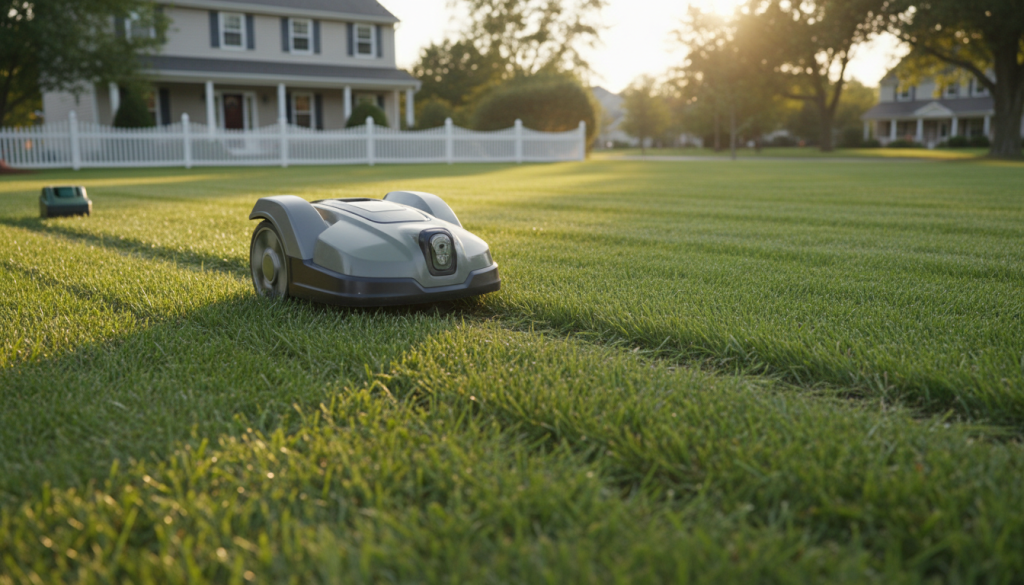
The Scenario & Core Assumptions
To ground our analysis, let’s define a typical scenario:
-
Property: A 1-acre suburban lot with a dedicated storage shed/garage.
-
User: A homeowner who values a well-kept lawn but also values their weekend time.
-
Mowing Season: 32 weeks per year in a temperate climate zone.
-
Comparative Units:
-
Traditional Option: A reputable 42-inch residential zero-turn riding mower (e.g., comparable to a mid-range John Deere Z300 series).
-
Robotic Option: A professional-grade robotic mower capable of handling 1+ acres with a modular battery (e.g., a Goko-class model).
-
-
Analysis Period: 5 years (a standard lifespan for a residential riding mower before major repairs, and a conservative mid-life point for a robotic mower).
Year-by-Year Cost Breakdown
Year 0: The Initial Investment
| Cost Component | Riding Mower | Robotic Mower | Notes |
|---|---|---|---|
| Equipment Purchase | $3,500 – $4,500 | $4,000 – $5,500 | Riding mower: Mid-range ZTR. Robotic: High-end model with extended battery. |
| Professional Installation | $0 (DIY) | $500 – $1,000 | Robotic mower may require RTK base setup & boundary mapping. |
| Accessories | $200 (Fuel can, oil) | $0 (Included) | |
| Year 0 TOTAL | ~$3,700 – $4,700 | ~$4,500 – $6,500 | Robotic mower has a 20-40% higher initial cost. |
Initial Verdict: The riding mower wins on upfront cost. This is the primary hurdle for robotic mower adoption.
Years 1-5: The Accumulating Operational Costs
This is where the financial picture fundamentally shifts.
1. Fuel vs. Electricity
-
Riding Mower: Consumes ~1 gallon of gas per hour. For 1 acre (~2 hours/week), that’s 64 gallons per season. At an average of $3.50/gallon, annual fuel cost = ~$224. Over 5 years: $1,120.
-
Robotic Mower: Consumes electricity. Estimated 30 kWh per month during season. At the U.S. average of $0.165/kWh, annual electricity cost = ~$53. Over 5 years: $265.
2. Scheduled Maintenance & Consumables
-
Riding Mower (Annual):
-
Oil & Filter Changes (2x per season): $80
-
Air Filter & Spark Plugs: $40
-
Two Sets of Blades (Sharpening/Replacement): $120
-
Annual Subtotal: ~$240 | 5-Year Total: $1,200
-
-
Robotic Mower (Annual):
-
Replacement Blade Kits (2x per year): $60
-
Annual Subtotal: ~$60 | 5-Year Total: $300
-
3. Repairs & Unscheduled Maintenance
-
Riding Mower: Complex mechanical system. Expect increasing costs:
-
Years 1-2: Minimal (~$50/year for belts/cables).
-
Years 3-5: Major components wear (spindles, deck belts, starter). Conservative average: $150/year. 5-Year Total: $750.
-
-
Robotic Mower: Solid-state electronics, fewer moving parts. Often includes a 3-year warranty. Low failure rate post-warranty. Conservative average: $75/year. 5-Year Total: $375.
4. The Value of Time: The Critical Intangible
This is the most significant differentiator.
-
Riding Mower: Requires 2 hours of active, weekly labor (prep, mow, clean-up, put away). Over 32 weeks = 64 hours/year. What is your time worth? At a conservative $25/hour (less than professional landscaping), that’s $1,600/year in time cost. 5-Year Total: $8,000.
-
Robotic Mower: Requires ~15 minutes of weekly oversight (app check, clearing occasional obstacles). That’s ~8 hours/year. At the same rate, time cost = $200/year. 5-Year Total: $1,000.
The 5-Year Total Cost of Ownership Comparison
| Cost Category | Riding Mower (5 Years) | Robotic Mower (5 Years) | Notes |
|---|---|---|---|
| Initial Purchase & Setup | $4,200 | $5,500 | Using mid-point averages. |
| Fuel / Electricity | $1,120 | $265 | |
| Scheduled Maintenance | $1,200 | $300 | |
| Repairs & Unscheduled | $750 | $375 | |
| Replacement / Depreciation | – | – | See “Year 5+” section below. |
| Subtotal (Direct Costs) | $7,270 | $6,440 | Robotic mower is already ~$800 cheaper. |
| Owner’s Time Cost (@ $25/hr) | $8,000 | $1,000 | The game-changing variable. |
| TOTAL COST OF OWNERSHIP | $15,270 | $7,440 | The robotic mower saves ~$7,830 over 5 years. |
The Analysis Reveals: When the value of your time is accounted for, the robotic mower’s TCO is less than half that of the riding mower over five years. Even ignoring time, its direct costs are competitive by Year 3-4.
Year 5 and Beyond: The Divergence Curve
-
Riding Mower: At the 5-year mark, a residential rider is often nearing the end of its reliable service life. Major engine or transmission work may be needed. Its resale value is minimal (often 20-30% of original cost). The homeowner faces another large capital expenditure.
-
Robotic Mower: A professional-grade unit has a lifespan of 8-10+ years. The primary wear item is the battery, which may need replacement around Year 6-7 at a cost of $500-$800—still far less than a new riding mower. The software and hardware remain current, and its effective “resale” value is the continued, uninterrupted service it provides for years to come.
Risk & Consideration Factors
-
Lawn Size: For lots under 0.5 acres, a high-quality walk-behind mower may be more cost-effective than either option here. For 1.5+ acres, the robotic mower’s time savings and fuel savings become even more dramatic.
-
Terrain Complexity: Slopes and obstacles increase wear on riding mowers (more repairs) but are handled efficiently by 4WD robotic models.
-
Alternative Service Cost: If you would otherwise pay for professional landscaping ($50-$80/week for 1 acre), the robotic mower pays for itself in under 2 years. Its 5-year cost is a fraction of a $12,800+ landscaping bill.
-
Environmental & Lifestyle Costs: The riding mower has intangible costs: noise pollution, carbon emissions, gasoline storage, and the physical exertion/vibration exposure for the operator.
Conclusion: Investing in Time and Tranquility
The financial analysis is clear: for a one-acre homeowner, a high-end robotic mower is not a luxury expense but a strategic investment that pays a substantial dividend in both cash and time.
The riding mower represents a high-operational-cost model: you continually pay in fuel, maintenance, repairs, and, most dearly, your personal hours. It is an asset that depreciates rapidly and demands your active participation.
The robotic mower represents a low-operational-cost, high-initial-investment model. You pay more upfront to acquire a durable, intelligent tool. In return, it drastically reduces or eliminates the recurring costs of fuel, heavy maintenance, and, most importantly, transforms lawn care from a weekly chore into a minimally managed, automated process.
The ultimate question is not “Can I afford a robotic mower?” but rather “Can I afford not to reclaim 60+ hours of my life each year?” Over five years, the robotic mower doesn’t just save you money—it gives you back an entire month of weekend freedom. In the economy of time, that is the most valuable return on investment any homeowner can make.